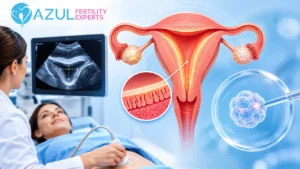
Summary: Embryo transfer success depends on more than embryo quality. Treatment may vary based on endometrial thickness, uterine structure, hormonal preparation, and any abnormalities found. By being aware of these considerations, patients can better plan for IVF and discuss relevant questions when contemplating overseas fertility care and alternative IVF treatment in Costa Rica.
A laboratory may carefully develop and select an embryo, but implantation ultimately occurs in the uterus. This makes the uterine environment a crucial part of IVF planning. Before an embryo transfer, fertility specialists evaluate the endometrium, uterine cavity, hormonal preparation, and other reproductive factors. For patients considering treatment abroad, understanding these factors is particularly important when evaluating IVF in Latin America cost alongside the quality and coordination of fertility care.
Uterine Factors That May Affect Embryo Transfer
Endometrial thickness is only one component of uterine assessment. The size and morphology of the uterine cavity may also be considered for embryo transfer.
Possible results may be:
- Polyps in the endometrium which may affect the cavity of the uterus.
- Fibroids (especially any that involve the cavity).
- Intrauterine adhesions (scars that can alter the shape of the cavity).
- Uterine septum: A structural variant which may need evaluation.
- Adenomyosis, which can be considered when assessing fertility and implantation.
Not all abnormalities need to be addressed prior to IVF. Its importance depends on localization, magnitude, severity, and the presence or absence of clinical symptoms, as well as a person’s treatment plan and reproductive history.
How These Factors Affect Transfer Timing?
Embryo transfer must occur when the endometrium is developed. Medications can sometimes be administered to prepare the uterus for a frozen embryo transfer; after that, the treatment protocol calls for the administration of progesterone. The embryo is then transferred when it is deemed to be the correct time for endometrial preparation.
Further evaluation may be advised prior to treatment if the lining is not reacting as expected or a uterine abnormality is detected.
In isolated cases, it may be possible to delay the transfer until a possible issue has been investigated or resolved. For international patients, this may be especially significant when arranging medical appointments, monitoring, medication, procedures and/or traveling.
How Is the Uterus Evaluated Before Transfer?
Transvaginal ultrasound is frequently used to measure endometrial thickness and provide information about the uterus. If other tests are advised for the anomaly identified on the ultrasound, they may be recommended.
These can include:
- Three-dimensional ultrasound
- Sonohysterography
- Hysteroscopy
- Further diagnostic imaging where appropriate, prior to the clinical situation.
These assessments are made to detect problems that might interfere with treatment planning. Not all patients are the same, and not every test is indicated for everyone; recommended investigations depend on the patient’s medical history, ultrasound findings, and the fertility specialist’s assessment.
Why Uterine Assessment Matters for IVF in Costa Rica?
When considering IVF medical tourism, patients typically look for the best price, ease of travel, services offered, and the clinic’s level of expertise.
A standard IVF cycle at Azul Fertility Experts starts at $4,328 USD. When comparing IVF costs in Latin America, patients should also ask which services are included in the quoted price and whether additional diagnostic tests, medication, or procedures may incur separate charges.
Azul Fertility Experts provides fertility treatment in Costa Rica and helps international patients coordinate their care.
Questions to Ask Your Fertility Specialist
If you’re thinking about transferring your embryo, ask the following before you do:
- In case of ultrasound use, is the endometrial thickness sufficient for the treatment?
- Have I been investigated well for the condition of my uterus?
- Will there be any problems with my treatment due to fibroids, polyps, adhesions, or adenomyosis?
- Will the endometrial/hormonal preparation be monitored?
- Are there any other tests/treatment necessary before transfer?
- How should I coordinate my travel dates with monitoring and the embryo transfer?
Here are some questions that can answer the patient’s rationale for their treatment plan.
Looking Beyond IVF Cost
When considering international fertility options, IVF Latin America cost may be a good starting point for comparing IVF prices. Still, cost doesn’t necessarily reflect quality or suitability for treatment.
Patients should also ask whether a clinic uses a different diagnostic approach, evaluates the uterus for embryo transfer, explains how to prepare for embryo transfer, describes how they treat the embryo, communicates with patients, and provides follow-up. To consider IVF medical tourism in Costa Rica, take these factors into account to gain a more holistic understanding of medical treatment.
Treatment should be personalized, not based upon the lowest advertised price.
Conclusion
The success of an IVF procedure depends on perfect coordination between embryo development and the uterine environment where it would be implanted. Various factors, such as endometrial thickness, uterine pathology or anatomy, hormonal conditioning, or potential abnormalities, can affect embryo transfer planning. Those considering IVF medical tourism in Costa Rica should understand these factors to prepare and make an informed decision. With a personalized assessment, the fertility expert will be able to determine the best treatment for the specific situation.
Talk about personalized fertility treatment and visit your IVF treatment options with Azul Fertility Experts in Costa Rica.
FAQs
1. What is endometrial thickness?
The thickness of the uterine lining is called endometrial thickness. One of its regular tests is an ultrasound that is used during IVF to measure the uterine environment before embryo transfer.
2. Can a thin endometrium affect IVF?
In some IVF clinics, IVF success and pregnancy may be hampered by a very thin endometrium. However, endometrial thickness at the time of embryo transfer does not guarantee success and is not the only indicator.
3. Does embryo transfer also have the potential to be impacted by fibroids or polyps?
Some fibroids and polyps are found in the cavity of the uterus and may be involved in implantation. Their importance depends on the size and location of the tumor(s) and the patient’s reproductive history.
4. What if an abnormality of the uterus is discovered?
Depending on the findings, the clinic may recommend further testing, monitoring, treatment, or changes to the embryo transfer schedule.
5. What should I consider when choosing IVF in Costa Rica?
When considering treatment cost, look at clinical evaluation, lab capabilities, treatment planning, international patient coordination, communication, follow-up, and more than just the cost of the treatment.